
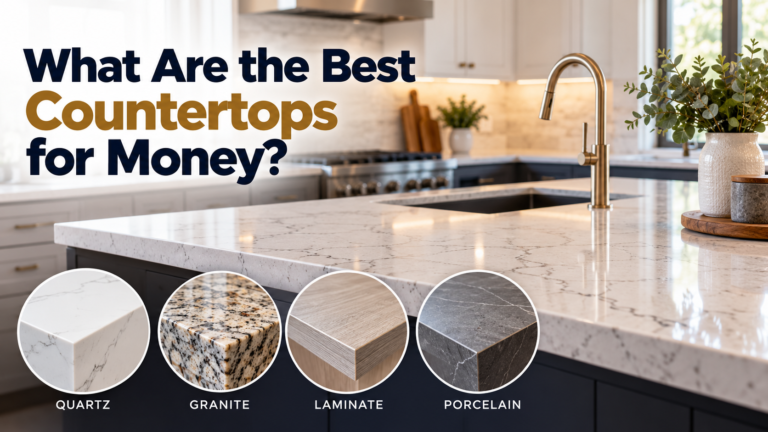
Choosing a new countertop is an important decision for any homeowner. Whether you are renovating your kitchen, upgrading your bathroom, or building a new home, you want a countertop that looks great, lasts for years, and fits your budget.
But what are the best countertops for money?
From my perspective, there is no single countertop material that is the best choice for everyone. The right option depends on your budget, expectations, lifestyle, and how you plan to use the space. A material that works perfectly for one homeowner might not be the right investment for another.
When helping customers choose countertops, I believe three factors matter most: price, durability, and overall cost of ownership. The goal is not simply to find the cheapest countertop. It is to find the right combination of quality, performance, appearance, and price.
In this guide, I will explain how to evaluate countertop options, what to look for when comparing quotes, and why choosing an experienced countertop company can make a significant difference to your overall investment.
What Does Value for Money Mean When Choosing Countertops?
Many homeowners begin their search by comparing prices. This is understandable because a countertop renovation can represent a significant part of a kitchen or bathroom renovation budget.
However, the initial purchase price tells only part of the story.
A countertop that costs less upfront may not necessarily provide the best long-term value. Similarly, a more expensive material is not automatically the best investment.
I recommend evaluating countertop value based on three main factors.
1. Initial Price
Your budget is an important starting point. Different countertop materials come at different price points, and the final cost depends on more than the material itself.
Factors that can affect your total countertop cost include:
- The type and quality of material selected
- The size and layout of the countertop
- The number of seams required
- Edge profiles and finishing details
- Sink, cooktop, and faucet cutouts
- Fabrication and installation requirements
- Removal and disposal of existing countertops, if required
When comparing prices, make sure you understand what you are paying for. Two quotes may look similar at first but cover different materials, services, and installation details.
2. Durability and Everyday Performance
Your countertop should suit the way you use your kitchen or bathroom.
For example, a family that cooks frequently may have different requirements from someone who primarily wants an attractive surface for occasional use. Some homeowners prioritize resistance to stains and scratches, while others focus more on appearance or keeping maintenance simple.
Consider how the material will perform under your expected daily use. Ask about its resistance to stains, heat, scratches, and impacts, as well as any care requirements or limitations.
It is also important to understand that no countertop material is completely indestructible. Even durable surfaces can be damaged if they are used incorrectly or exposed to conditions outside the manufacturer’s recommendations.
3. Overall Cost of Ownership
The overall cost of ownership includes more than the amount you pay on installation day.
It also includes the maintenance, repairs, and potential replacement costs you may face over time.
Before making a decision, consider:
- Whether the material requires periodic sealing or specialized care
- How easily it can be cleaned and maintained
- Whether repairs may be needed under normal use
- How long you expect the countertop to serve your household
- Whether the material suits your long-term renovation plans
The best value comes from selecting a countertop that meets your needs without creating unnecessary expenses or maintenance responsibilities later.
Which Countertop Material Offers the Best Value for Money?
There are several countertop materials worth considering, including quartz, granite, laminate, and porcelain. Each has its own advantages, limitations, and price considerations.
I do not believe in recommending one material to every customer. My approach is to understand what the customer needs first and then help them choose a suitable option.
Quartz Countertops
Quartz is a popular option for homeowners who want a modern appearance and relatively straightforward maintenance.
Engineered quartz is available in a wide range of colours and patterns, including designs that resemble natural stone. Its nonporous surface generally does not require sealing, making routine cleaning relatively simple.
Quartz can be a good choice for homeowners who prioritize:
- A consistent appearance
- A wide selection of colours and patterns
- Low routine maintenance
- A contemporary kitchen or bathroom design
However, quartz is not indestructible. It can be damaged by excessive heat, and its resistance to scratches and impacts depends on the product and conditions of use. Hot cookware should not be placed directly on the surface.
Whether quartz offers the best value depends on the specific product, installation cost, and your expectations.
Granite Countertops
Granite is a natural stone that offers distinctive patterns and natural variations. No two slabs are exactly alike, which appeals to homeowners who prefer a more natural look.
Granite can provide excellent long-term value when the selected stone is suitable for the application and properly fabricated and installed.
Potential advantages include:
- Natural patterns and colours
- Good durability for everyday kitchen use
- Resistance to heat under appropriate conditions
- A distinctive appearance that can complement many design styles
Some granite varieties require periodic sealing, and maintenance requirements can vary depending on the stone. Granite can also crack or chip under certain conditions, particularly around unsupported areas or edges.
When considering granite, I recommend looking at the actual slab whenever possible. Natural variation means the sample you see in a showroom may not perfectly represent the finished countertop.
Laminate Countertops
Laminate can be a practical option for homeowners working with a tighter budget.
It is available in many colours and patterns, including designs inspired by wood and natural stone. It can also be suitable for projects where controlling the initial cost is a priority.
Its advantages include:
- A generally lower upfront cost than many stone options
- A wide range of design choices
- Relatively simple everyday cleaning
- Suitability for many budget-conscious renovations
However, laminate has limitations. It can be damaged by excessive heat, cut directly with sharp objects, or affected by moisture if water penetrates vulnerable seams or edges.
For homeowners who want an attractive countertop at a lower initial cost and understand these limitations, laminate may offer good value.
Porcelain Countertops
Porcelain is another option for homeowners who want a contemporary, refined appearance combined with strong performance characteristics.
Depending on the product, porcelain countertops can offer excellent resistance to heat, UV exposure, and staining. They are available in various finishes and designs, including options that resemble marble and other natural stones.
Porcelain may be worth considering when appearance, heat resistance, and particular performance requirements are priorities.
However, fabrication and installation require appropriate expertise and equipment. Edges can be vulnerable to chipping from impacts, and the total installed cost can vary considerably depending on the product and project.
As with any material, the right decision depends on the specific product, the installation requirements, and your budget.
How to Choose the Right Countertop for Your Budget
Rather than starting with a particular material, I recommend starting with your requirements.
Think about what matters most to you, then compare materials that meet those needs.
If Your Priority Is a Lower Initial Cost
Start by identifying materials that fit your budget without compromising on essential requirements.
Laminate may be suitable for some projects, while certain quartz or granite options may also fit depending on the product, countertop size, and installation details.
Ask for a complete installed price rather than comparing material prices alone. This gives you a more realistic picture of what the project will cost.
If Your Priority Is Durability
Consider how the countertop will be used every day.
A busy family kitchen may require different performance characteristics from a bathroom vanity or a rarely used secondary kitchen.
Ask your countertop provider about the material’s limitations, maintenance requirements, and suitability for your specific application.
Do not assume that a higher price automatically means better performance. Compare the actual properties of the materials you are considering.
If Your Priority Is Appearance
Consider the colour, pattern, finish, edge details, and overall design of your space.
Natural stone offers unique variation, while engineered materials can provide more consistent patterns. Some products are designed to replicate premium natural stone without using the original material.
If appearance is a major factor, view larger samples or actual slabs where possible. This can help you understand how the material will look across the entire countertop.
If Your Priority Is Long-Term Value
Look beyond the initial price and consider maintenance, durability, installation quality, and expected use.
A countertop that meets your requirements and is installed correctly can be a better investment than a cheaper option that does not suit your needs.
The objective is to spend your money where it makes a meaningful difference, rather than paying more for features you do not need or saving money in areas where quality matters.
Why the Cheapest Countertop Quote Is Not Always the Best Choice
One of the most important lessons I would share with homeowners is that the lowest quote does not necessarily represent the best value for money.
I have seen a customer focus heavily on getting the lowest price and later realize that compromises had been made in material quality. The customer also faced problems associated with working with an inexperienced team, which ultimately cost more money.
This is a situation homeowners should try to avoid.
When you choose a countertop based primarily on price, you may overlook important differences in the material being supplied, the fabrication process, the installation team’s experience, and the services included in the quote.
A lower price is not automatically a warning sign, just as a higher price is not proof of superior quality. What matters is understanding what each company is offering and whether it represents fair value.
Before accepting a quote, take time to understand the complete scope of work.
What Should You Check When Comparing Countertop Companies?
The material is only one part of the final result. The company you choose also plays an important role in the quality of your countertop project.
I recommend evaluating countertop companies based on their previous work, the details of their quotes, the materials they use, and their experience.
Review Their Previous Work
Ask to see examples of completed countertop projects.
Look for the quality of the finished edges, the consistency of seams, the appearance of cutouts, and the overall finish. If possible, review projects similar to yours in terms of material, layout, and complexity.
Photographs can help you understand a company’s style and capabilities, but ask questions if you need more information about the work shown.
A company that can demonstrate relevant experience gives you a better basis for evaluating its suitability for your project.
Understand Exactly What the Quote Includes
Do not compare quotes based only on the final dollar amount.
Review the scope of work and confirm which services are included. Depending on your project, you may need to check whether the quote covers:
- Material supply
- Measurement and templating
- Fabrication
- Edge profiles
- Sink and cooktop cutouts
- Delivery and installation
- Removal and disposal of existing countertops
- Any additional work required for the installation
Not every project requires every service, and not every company structures its quote in the same way. The important thing is to understand what is included and identify any potential additional costs before work begins.
This makes it easier to compare quotes fairly and reduces the risk of unexpected expenses.
Check the Material Being Supplied
Make sure you understand the material specified in the quote.
For natural stone, ask about the particular slab or stone variety. For engineered products, confirm the product name, finish, and relevant specifications.
Material quality, appearance, thickness, and product characteristics can differ, even when two options look similar in photographs.
If you are comparing two quotes, ensure that you are comparing reasonably equivalent products and specifications.
Evaluate the Company’s Experience
Countertop measurement, fabrication, and installation require practical knowledge and attention to detail.
An experienced team is better positioned to identify potential installation challenges, explain material limitations, and plan the work appropriately.
Ask how the company handles complex layouts, seams, cutouts, and any project-specific requirements.
Experience does not guarantee that every project will be problem-free, but reviewing relevant work and asking informed questions can help you make a more confident decision.
Why End-to-End Countertop Service Matters
I also recommend working with a countertop company that provides an end-to-end service whenever it suits your project and budget.
When the process is coordinated from measurement through fabrication and installation, it can make communication and accountability easier.
Instead of managing several separate providers, you have a clearer understanding of who is responsible for the different stages of the project.
An end-to-end service may include:
- Helping you select a suitable material
- Measuring the space and preparing the template
- Planning fabrication details
- Coordinating delivery
- Completing the installation
- Explaining care and maintenance requirements
The exact services will vary between companies, so confirm what is included before signing an agreement.
The advantage is not simply convenience. A coordinated process can help identify potential issues earlier, clarify responsibilities, and make it easier to address questions throughout the project.
For homeowners, that can contribute to a better overall experience and help protect the value of the investment.
Common Mistakes to Avoid When Buying Countertops
Even when homeowners have a clear budget, a few common mistakes can make the decision more difficult or expensive than necessary.
Choosing a Material Before Understanding Your Needs
A countertop may look beautiful in a showroom but may not be the best fit for your lifestyle.
Consider your cooking habits, cleaning preferences, design expectations, and budget before making your final selection.
Comparing Quotes Without Checking the Scope
Two companies may quote different prices because they are offering different products or services.
Read each quote carefully and ask questions about anything that is unclear.
Assuming Expensive Means Better
Premium materials can offer particular aesthetic or performance benefits, but not every homeowner needs them.
Choose a material that delivers the features you value rather than paying extra simply because an option is more expensive.
Ignoring Installation Quality
Even a high-quality countertop can disappoint if it is poorly measured, fabricated, or installed.
Review the company’s experience and previous work, and ask how the installation will be handled.
Overlooking Maintenance Requirements
Different materials have different care requirements.
Understand how to clean and maintain your chosen countertop, what products to avoid, and whether periodic treatments are necessary.
So, What Are the Best Countertops for Money?
The best countertop for your money is the one that meets your requirements, fits your budget, performs well for its intended use, and is installed properly.
For some homeowners, laminate may be the right choice because keeping upfront costs low is the priority. Others may prefer quartz for its design options and relatively low routine maintenance, granite for its natural character, or porcelain for particular aesthetic and performance requirements.
There is no universal winner because every project has different priorities.
My advice is to focus on three things: the material, the company, and the complete cost of the project.
First, choose a material that suits your needs. Second, review the countertop company’s previous work and experience. Finally, compare quotes carefully to understand what is included and whether the price represents good value.
Do not make your decision based on price alone.
A countertop is a long-term part of your home, and the choices you make today can affect your satisfaction with the finished space for years to come.
Final Advice: Invest in the Right Countertop, Not Just the Lowest Price
If I could give homeowners one piece of advice, it would be this: review the company’s previous work and experience, and choose a countertop provider that can deliver the complete service your project requires.
Take time to understand your options, ask questions, and compare quotes based on what you are actually receiving.
The cheapest option may be suitable for your project, but it should be a decision based on value rather than price alone.
When you combine the right material with quality workmanship and a well-coordinated installation, you are in a much stronger position to get the best value for your money.
If you are planning a countertop renovation, start by identifying your priorities and budget. Then speak with an experienced countertop professional who can help you evaluate suitable materials and understand the full scope of the work before you commit.
The best investment is not necessarily the most expensive countertop or the cheapest one. It is the countertop that delivers the right balance of price, durability, appearance, and long-term value for you.